
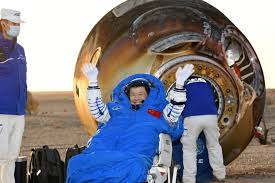
Stranded in Orbit: Astronauts’ Return Delayed by Debris

Astronauts Stranded After Debris Hits Their Return Capsule Three astronauts aboard China’s space station now face an uncertain return home. Their designated return capsule appears to have sustained damage. The sidelining of their original spacecraft threatens their planned descent. Impact Raises Safety Alarm The suspected debris strike has cracked one of the windows on the return module. Mission control conducted detailed impact assessments and found structural concerns that make using the capsule risky. Although the damage is not catastrophic, engineers say the crack limits the craft’s ability to withstand re-entry stress. Back-Up Plan in Motion To address this crisis, a standby spacecraft is docked at the station. It arrived only recently with a fresh crew, but now must also serve as the emergency return vehicle. Engineers are running simulations to certify its systems, focusing on propulsion, thermal shields, and life support. Meanwhile, the ground team prepares for a potential rescue or evacuation. Life on the Station Amid Tension Inside the station, the two crews—safe but anxious—are working together. They continue with scientific experiments, cargo transfers, and routine maintenance. Despite the looming return uncertainty, the astronauts maintain a disciplined schedule, supporting each other under stressful circumstances. Monitoring and Risk Assessment Flight controllers are running a full risk analysis. They study orbital trajectories, check micrometeoroid impacts, and evaluate the cracked module’s integrity. Additionally, they prepare emergency procedures and test potential undocking sequences. Every scenario is being rehearsed on the ground to ensure fast execution, if needed. Long-Term Implications for Human Spaceflight This incident underlines the harsh reality: even tiny debris in low Earth orbit can endanger lives. As more satellites occupy space and debris fragments proliferate, the risk of collision goes up. Planners and engineers must improve shielding, tracking systems, and contingency strategies to keep crews safe in future missions. Psychological Toll on Crew and Ground Teams There is also a significant emotional burden. The stranded astronauts now live with a persistent anxiety about their return. On Earth, mission leaders face public and political pressure to resolve the crisis quickly. Yet safety remains the top priority. Officials emphasize that they will not rush the decision to bring the crew back. Hope and Determination Still, there is hope. The alternate spacecraft has proven reliable in prior missions. If it passes all safety checks, the crew could return within days. Meanwhile, the astronauts remain focused, disciplined, and cooperative. They know their fate hinges on flawless engineering and quick but careful leadership. In the end, this space drama could serve as a powerful reminder of the perils of orbital debris—and the resilience of human spacefarers when their lives hang in the balance.

Astronauts Stranded After Debris Hits Their Return Capsule

Three astronauts aboard China’s space station now face an uncertain return home. Their designated return capsule appears to have sustained damage. The sidelining of their original spacecraft threatens their planned descent.

Impact Raises Safety Alarm

The suspected debris strike has cracked one of the windows on the return module. Mission control conducted detailed impact assessments and found structural concerns that make using the capsule risky. Although the damage is not catastrophic, engineers say the crack limits the craft’s ability to withstand re-entry stress.

Back-Up Plan in Motion

To address this crisis, a standby spacecraft is docked at the station. It arrived only recently with a fresh crew, but now must also serve as the emergency return vehicle. Engineers are running simulations to certify its systems, focusing on propulsion, thermal shields, and life support. Meanwhile, the ground team prepares for a potential rescue or evacuation.

Life on the Station Amid Tension

Inside the station, the two crews—safe but anxious—are working together. They continue with scientific experiments, cargo transfers, and routine maintenance. Despite the looming return uncertainty, the astronauts maintain a disciplined schedule, supporting each other under stressful circumstances.

Monitoring and Risk Assessment

Flight controllers are running a full risk analysis. They study orbital trajectories, check micrometeoroid impacts, and evaluate the cracked module’s integrity. Additionally, they prepare emergency procedures and test potential undocking sequences. Every scenario is being rehearsed on the ground to ensure fast execution, if needed.

Long-Term Implications for Human Spaceflight

This incident underlines the harsh reality: even tiny debris in low Earth orbit can endanger lives. As more satellites occupy space and debris fragments proliferate, the risk of collision goes up. Planners and engineers must improve shielding, tracking systems, and contingency strategies to keep crews safe in future missions.

Psychological Toll on Crew and Ground Teams

There is also a significant emotional burden. The stranded astronauts now live with a persistent anxiety about their return. On Earth, mission leaders face public and political pressure to resolve the crisis quickly. Yet safety remains the top priority. Officials emphasize that they will not rush the decision to bring the crew back.

Hope and Determination

Still, there is hope. The alternate spacecraft has proven reliable in prior missions. If it passes all safety checks, the crew could return within days. Meanwhile, the astronauts remain focused, disciplined, and cooperative. They know their fate hinges on flawless engineering and quick but careful leadership.

In the end, this space drama could serve as a powerful reminder of the perils of orbital debris—and the resilience of human spacefarers when their lives hang in the balance.